For Families
You can't be there every minute. You still want to know they're OK.
Maybe it's your mom across town, your dad 2 states away, or a veteran in your family who lives alone. NestCara helps you stay close, and know when something is wrong, using the TV they already have.
What we heard
Families, caregivers and the people who serve them told us what keeps them up at night.5
You're carrying a lot.
63 million Americans are family caregivers, nearly 50% more than in 2015. 7 in 10 of them also work a job.1
They want to stay home.
About 3 in 4 adults 50 and older want to stay in their homes as long as possible.2
Falls happen, and they don't always tell you.
More than 1 in 4 older people fall each year, and less than half tell their doctor.3
Memory loss changes everything.
About 7.4 million Americans 65 and older are living with Alzheimer's in 2026. Nearly 13 million people give unpaid care to someone with dementia, more than 19 billion hours in 2025.4
Distance and loneliness.
In rural areas, the doctor can be hours away and family can't visit often. People told us their loved ones just need connection.5
How NestCara helps
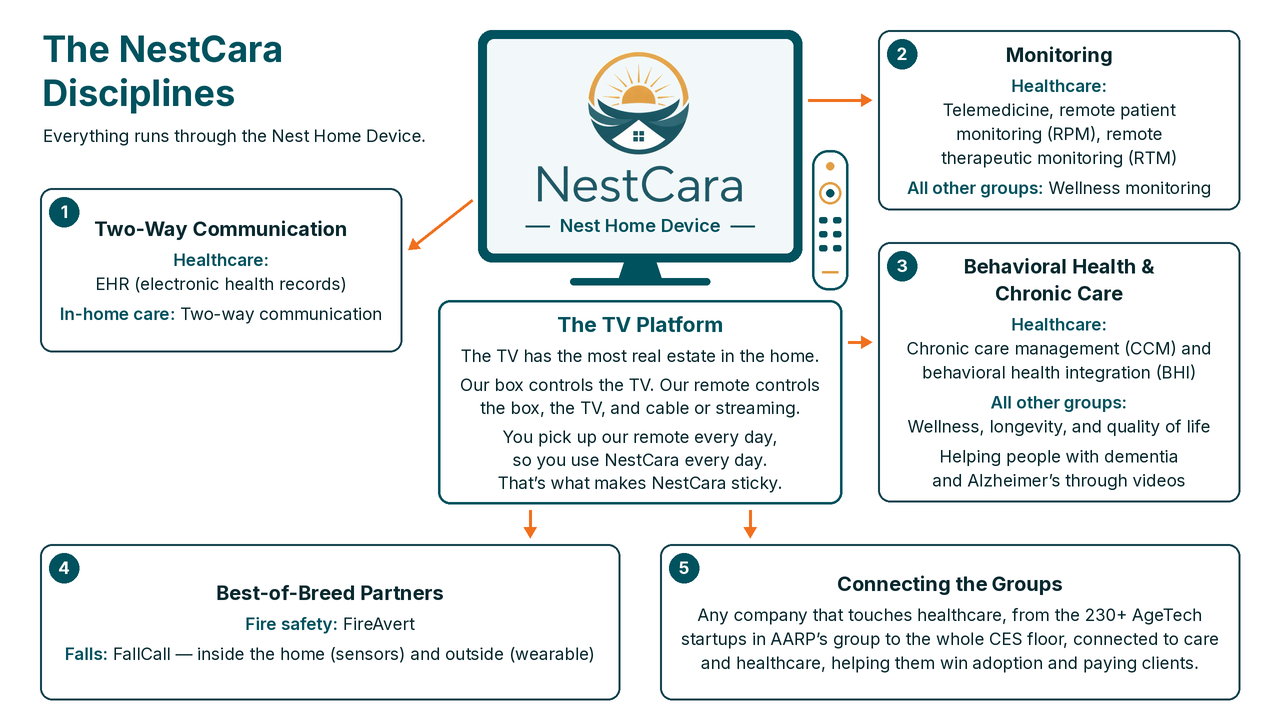
NestCara turns the TV in the living room into a simple way to check in, get help and see a clinician. You stay in the loop from your phone.
- A morning check-inThe TV asks how they're feeling. You get a short, plain update, like “Mom checked in this morning and said she feels good.”
- Video calls with 1 tapCall right to their TV from your phone. Send messages and photos that show up on the screen.
- Alerts when it mattersIf there's a fall (through Fall Call) or a fire risk at the stove (through FireAvert), the person is told first. Then family and the care team are told, in the order set for that home.
- Nothing new to learnThe Nest HD plugs into the TV. A simple remote and their voice do the rest.
- Help for memory lossVideos made to support people living with dementia and Alzheimer's.
- Their privacy, their sayThe camera and mic have switches on the box. Only the legal representative can sign or change consent. If your loved one can decide for herself, she is her own legal representative and can change consent right on the TV.

What it means for your family
- Peace of mind, wherever you are.
- More time being family, and less time checking up.
- Your loved one stays independent, at home.
- The care team sees what you see.
- Help that works for aging parents, veterans and anyone who needs care at home.
Where your family fits
Families sit at the center, next to the person at home. Home care, therapists, clinics and the doctor's office can all connect through the same box, so everyone sees the same picture, with consent.
Tell us what your family needs
NestCara is not on the market yet. Families who talk with us now help shape what it does at home.
Sources
- 1. AARP and National Alliance for Caregiving, Caregiving in the US 2025 (July 24, 2025): 63 million Americans are family caregivers, nearly a 50% increase since 2015; 7 in 10 family caregivers are employed. https://www.aarp.org/pri/topics/ltss/family-caregiving/caregiving-in-the-us-2025/
- 2. AARP, 2021 Home and Community Preferences Survey: about three-quarters of adults 50 and older would like to stay in their current homes or communities for as long as possible. https://www.aarp.org/pri/topics/livable-communities/housing/2021-home-community-preferences/
- 3. CDC, Facts About Older Adult Falls (reviewed September 8, 2026): more than 1 in 4 older people fall each year, but less than half tell their doctor; falling once doubles the chance of falling again; about 4.5 million emergency department visits and 1.4 million hospitalizations each year; home hazards are a risk factor. https://www.cdc.gov/falls/data-research/facts-stats/index.html
- 4. Alzheimer's Association, Alzheimer's Disease Facts and Figures: an estimated 7.4 million Americans age 65 and older are living with Alzheimer's in 2026; nearly 13 million Americans provide unpaid care for people with Alzheimer's or other dementias, more than 19 billion hours in 2025. https://www.alz.org/alzheimers-dementia/facts-figures
- 5. Long Haven Partners, 230+ interviews across manufacturers, healthcare, agencies and all 5 verticals, January to September 2026. Findings are paraphrased; no one is quoted by name.
- 6. Long Haven Partners, research and channel findings summarized in the Master Business Plan, October 2026.
- 7. U.S. Bureau of Labor Statistics, Occupational Outlook Handbook, Home Health and Personal Care Aides: about 760,500 openings projected each year, on average, from 2025 to 2035; employment projected to grow 18%. https://www.bls.gov/ooh/healthcare/home-health-aides-and-personal-care-aides.htm
Statistics come only from the sources above. Interview findings are paraphrased and do not name the people we spoke with.